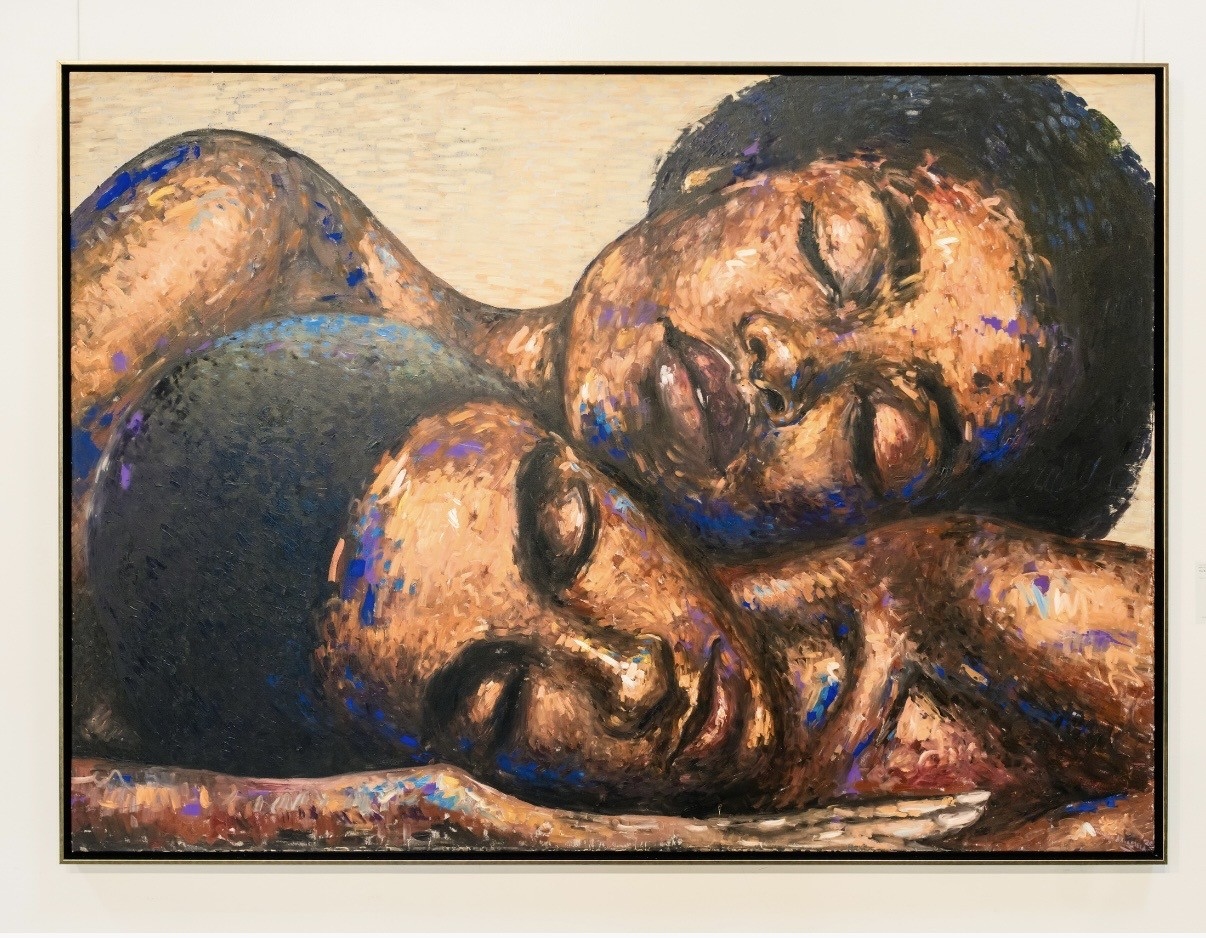
His answer is material. Across his paintings, presence is built through accumulation. Oil gathers into surface. Paint thickens where the image carries the most weight. In several works, texture and incorporated materials deepen the surface, allowing the painting to carry evidence of weight as well as image. The figure is not treated as symbol or ornament. She is treated as substance.
Dakamela paints women he has known and women he has not, but the proposition remains constant. Each figure carries something. The painting does not always name what it is.
Across the eight works, the investigation moves through distinct registers: the structural embrace of The Women Who Hold Me, the direct address of Being 08, the inward turn of Udadewethu, the sustained profile of Still 02, the collective rhythm of Sun Jazz Night in Soweto, the near-monochrome severity of Still 01, the standing figure of Garden of Eden, and the shared mass of What We Carry Between Us.
Yokanna moves in the opposite direction. Where Dakamela accumulates, Yokanna reduces. His works proceed through erasure as much as through mark. The palette knife does not simply form the face. It interrupts it, withholds it, and asks what remains when recognition is incomplete.
In Held in Disappearance, the face is built from vertical mark and pulled apart by vertical erasure within the same gesture. In The First Fracture, the chapter’s youngest figure looks away. In Presence Without Permission, she looks back without softening for the viewer. In The Discipline of Stillness, the eyes close as boundary rather than retreat. In Held in Ascent, the face lifts, but the weight remains.
Across both artists, holding is rendered as practice. Composure is not stillness. It is labor. It is the work of remaining present under weight.
This chapter argues for a figure who refuses reduction. She is not offered as spectacle. She is not arranged for easy consumption. She is a presence who knows what she is carrying, even when the viewer does not.
The exhibition leaves the viewer not with an answer, but with a threshold.